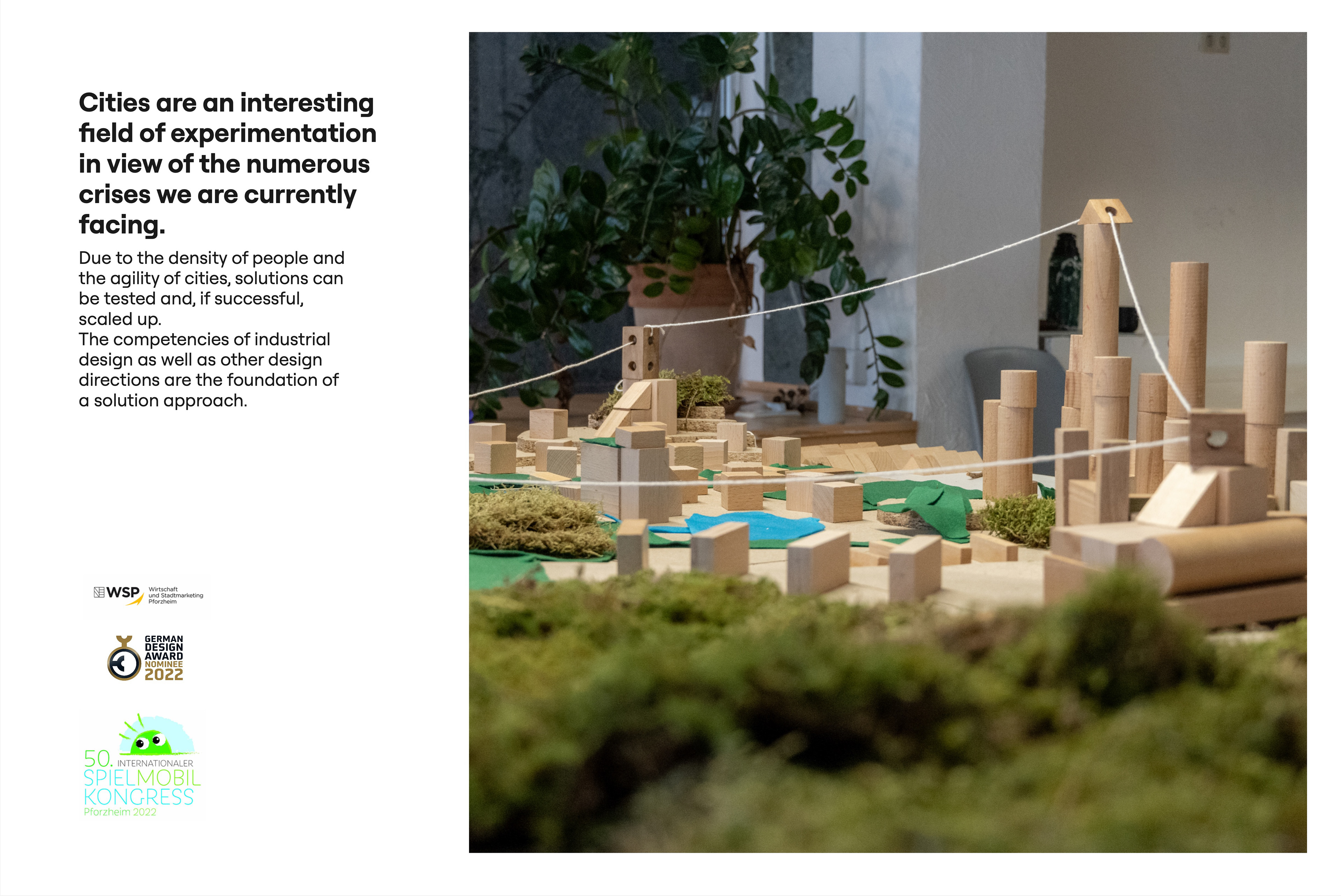
Cities are an interesting field of experimentation in view of the numerous crises we are currently facing. Close-up of a city model made of wooden blocks and cylinders, moss and green and blue felt, with a string stretched between two wooden towers. Text: Due to the density of people and the agility of cities, solutions can be tested and, if successful, scaled up. The competencies of industrial design as well as other design directions are the foundation of a solution approach. Logos of WSP Wirtschaft und Stadtmarketing Pforzheim, German Design Award Nominee 2022 and 50. Internationaler Spielmobil Kongress Pforzheim 2022.
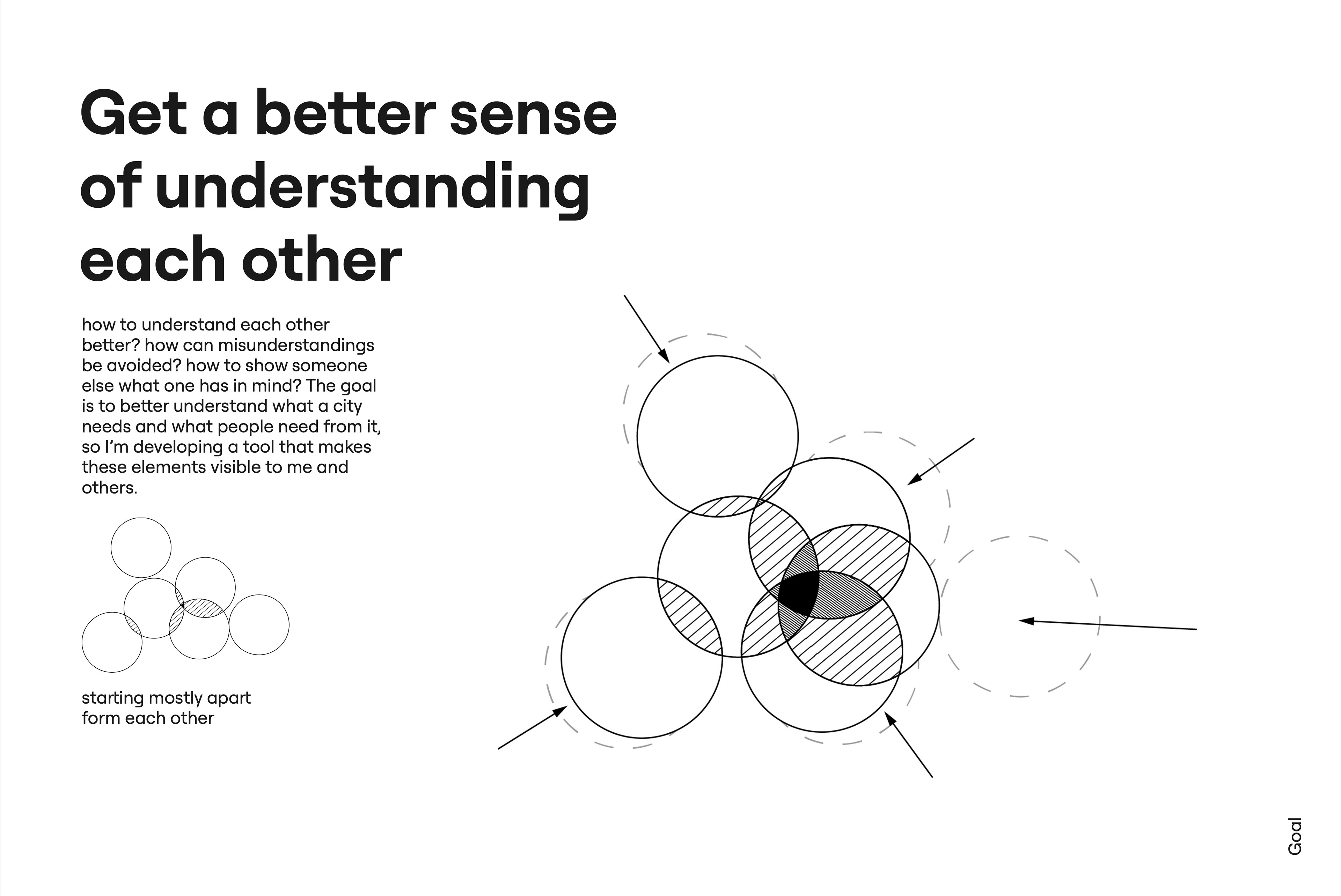
Get a better sense of understanding each other. Line drawing: five circles pushed together by arrows, their overlaps hatched and the shared centre filled black; a small drawing beside it shows the same circles barely touching. Text: How to understand each other better? How can misunderstandings be avoided? How to show someone else what one has in mind? The goal is to better understand what a city needs and what people need from it, so I'm developing a tool that makes these elements visible to me and others. Caption of the small drawing: starting mostly apart from each other.
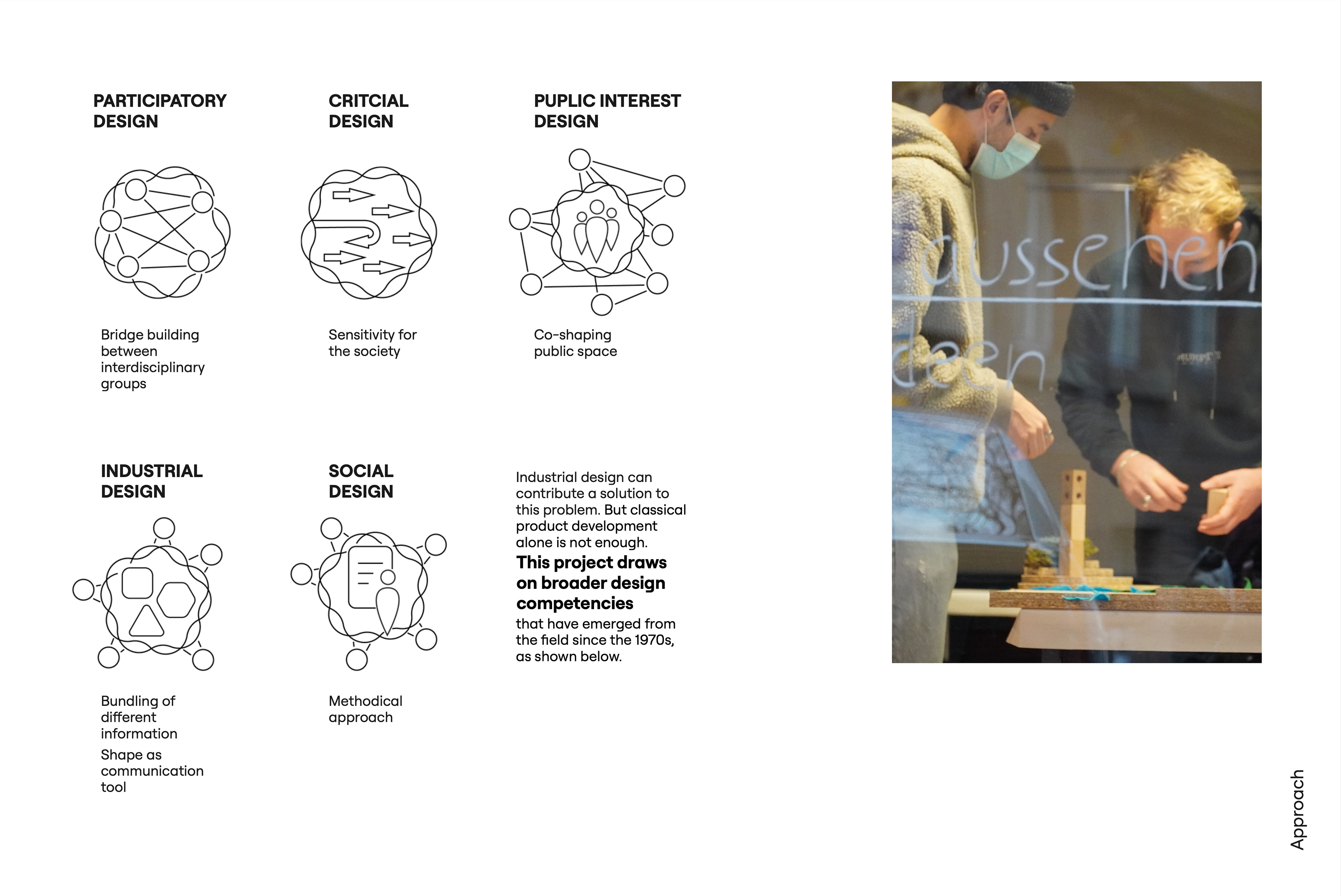
Five design fields, each with a line icon, and a photo taken through a shop window of two men building with wooden blocks, with handwritten words on the glass. Participatory Design: connected points inside a wavy ring. Bridge building between interdisciplinary groups. Critical Design: arrows, one of them turning back. Sensitivity to society. Public Interest Design: a group of people at the centre of a network. Co-shaping public space. Industrial Design: square, hexagon and triangle inside a ring. Bundling of different information. Shape as communication tool. Social Design: a document and a person. Methodical approach. Text: Industrial design can contribute a solution to this problem. But classical product development alone is not enough. This project draws on broader design competencies that have emerged from the field since the 1970s, as shown below.
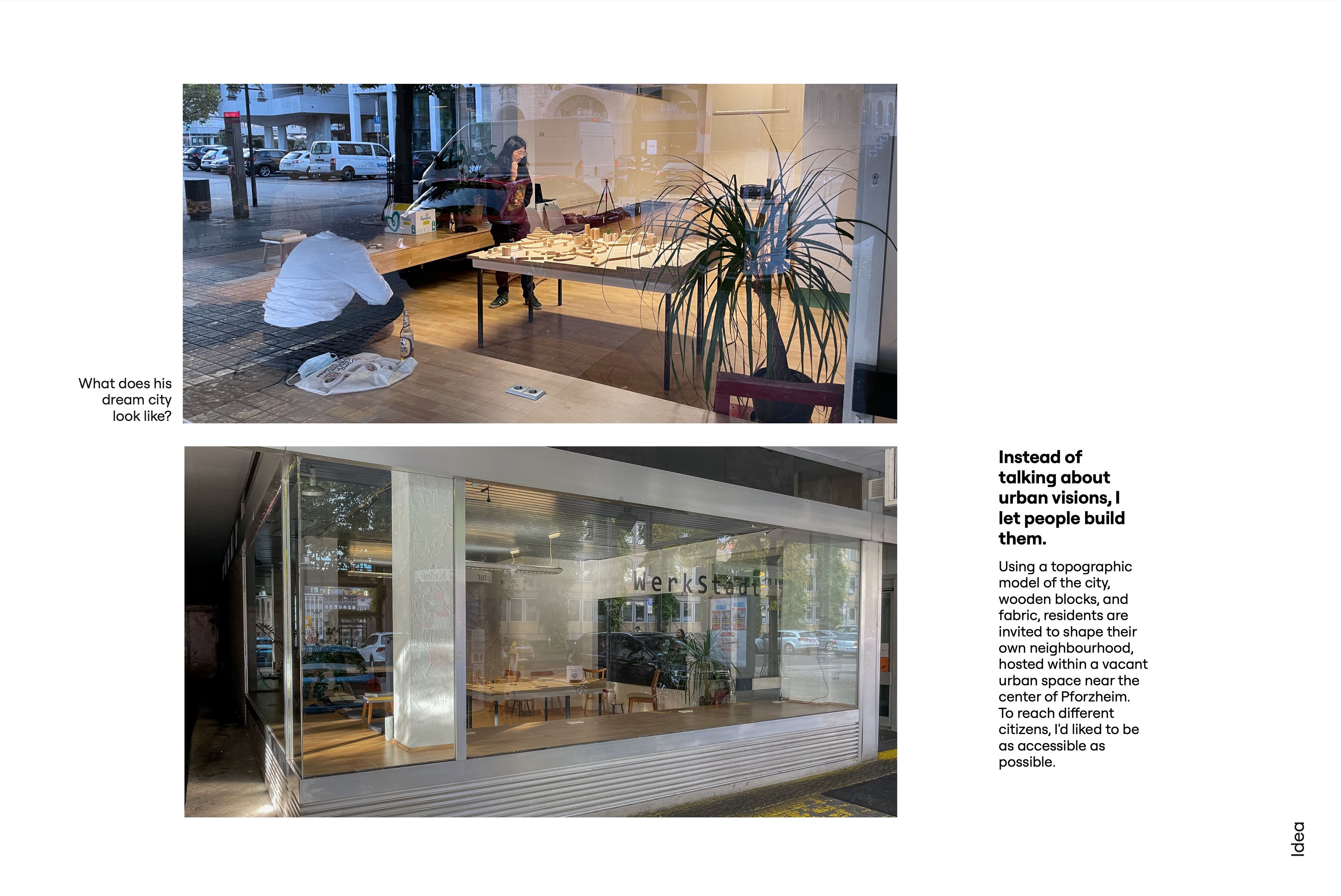
Instead of talking about urban visions, I let people build them. Two photos of a vacant shop with large windows and the lettering WerkStadt: seen through the glass, a person stands at a table with a wooden city model while another crouches in front of the window; the second photo shows the shopfront from the street with tables and chairs inside. Caption: What does his dream city look like? Text: Using a topographic model of the city, wooden blocks, and fabric, residents are invited to shape their own neighbourhood, hosted within a vacant urban space near the center of Pforzheim. To reach different citizens, I'd like to be as accessible as possible.
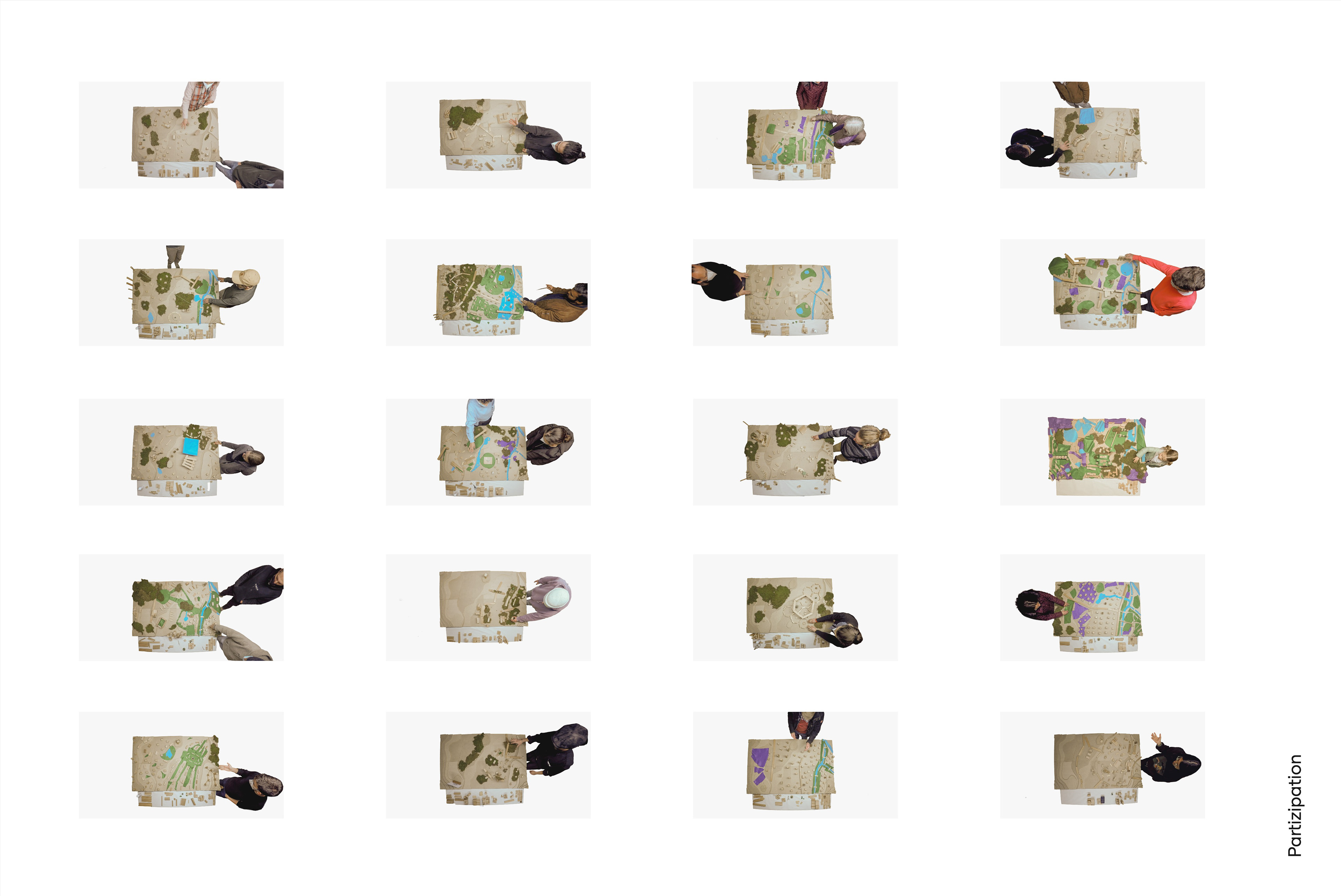
Grid of 20 photos from above, each showing one or two people at the topographic model of Pforzheim. Every model is built differently, with wooden blocks, moss and blue, green and purple felt.
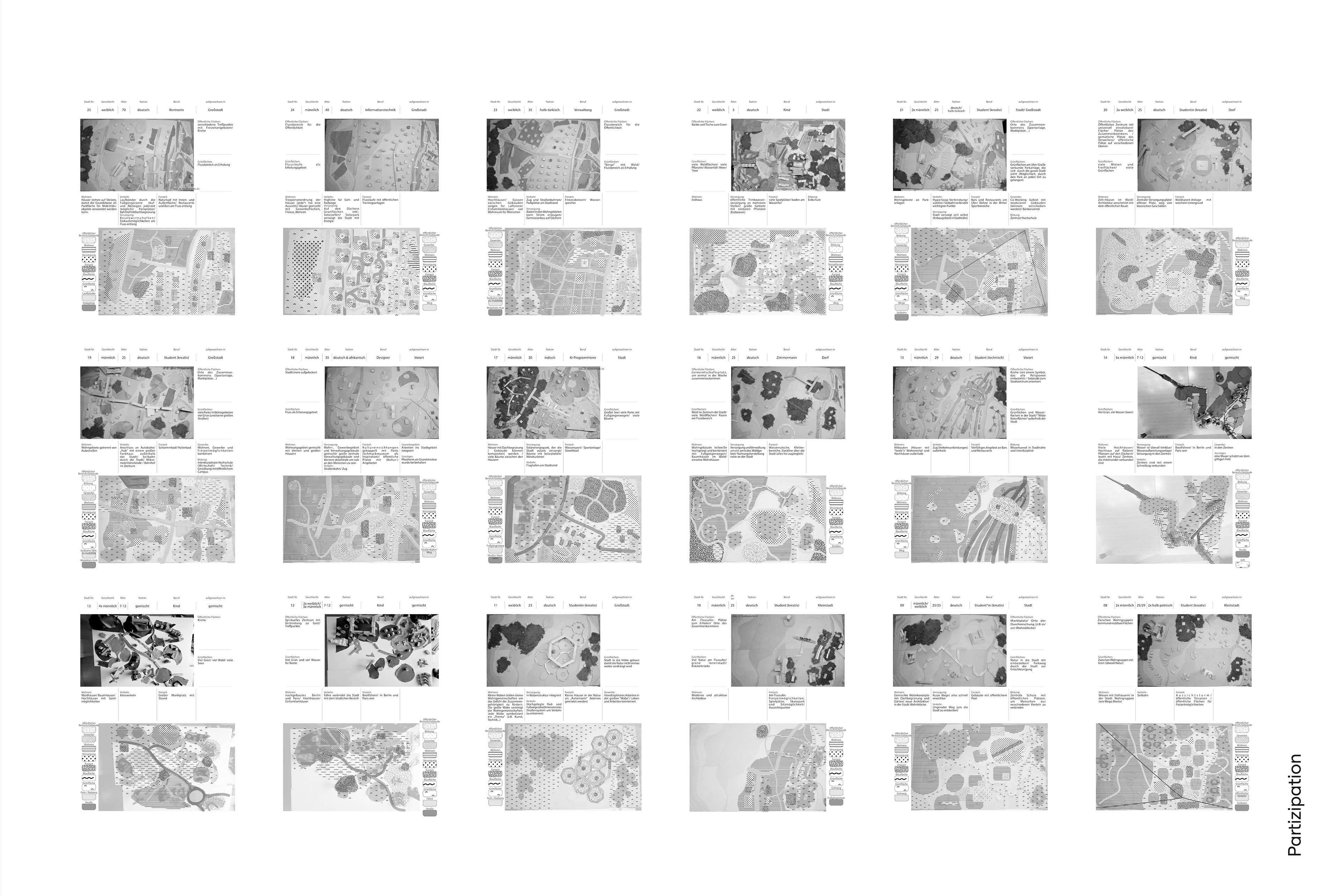
Eighteen documentation sheets in German, one for each built city, numbered from 25 down to 08. Each sheet has a header with city number, gender, age, nationality, profession and the kind of place the builders grew up in, a black-and-white photo of the model from above, short notes on public spaces, green spaces, housing, mobility and leisure, and a hatched map of the land uses with a legend.
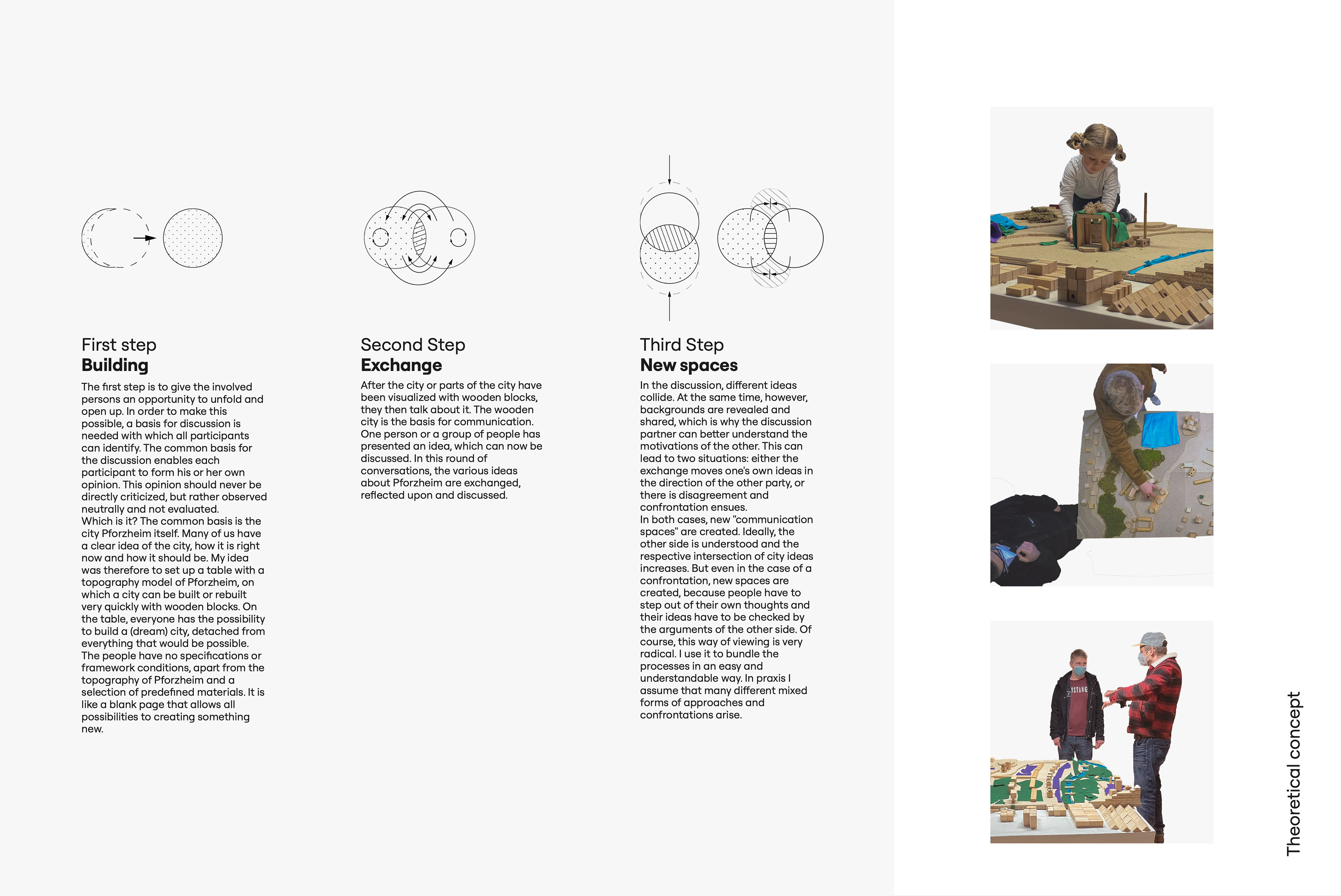
Three steps, each with a circle diagram, and three photos of participants: a girl building at the model, two people seen from above placing blocks, and two men in face masks talking beside a model. First step, Building: a dashed circle turns into a filled one. The first step is to give the involved persons an opportunity to unfold and open up. In order to make this possible, a basis for discussion is needed with which all participants can identify. The common basis for the discussion enables each participant to form his or her own opinion. This opinion should never be directly criticized, but rather observed neutrally and not evaluated. What is it? The common basis is the city Pforzheim itself. Many of us have a clear idea of the city, how it is right now and how it should be. My idea was therefore to set up a table with a topographic model of Pforzheim, on which a city can be built or rebuilt very quickly with wooden blocks. On the table, everyone has the possibility to build a (dream) city, detached from everything that would be possible. The people have no specifications or framework conditions, apart from the topography of Pforzheim and a selection of predefined materials. It is like a blank page that allows all possibilities for creating something new. Second Step, Exchange: two overlapping circles with arrows running between them. After the city or parts of the city have been visualized with wooden blocks, they then talk about it. The wooden city is the basis for communication. One person or a group of people has presented an idea, which can now be discussed. In this round of conversations, the various ideas about Pforzheim are exchanged, reflected upon and discussed. Third Step, New spaces: circles pushed together by arrows, their overlaps hatched. In the discussion, different ideas collide. At the same time, however, backgrounds are revealed and shared, which is why the discussion partner can better understand the motivations of the other. This can lead to two situations: either the exchange moves one's own ideas in the direction of the other party, or there is disagreement and confrontation ensues. In both cases, new "communication spaces" are created. Ideally, the other side is understood and the respective intersection of city ideas increases. But even in the case of a confrontation, new spaces are created, because people have to step out of their own thoughts and their ideas have to be checked by the arguments of the other side. Of course, this way of viewing is very radical. I use it to bundle the processes in an easy and understandable way. In practice I assume that many different mixed forms of approaches and confrontations arise.
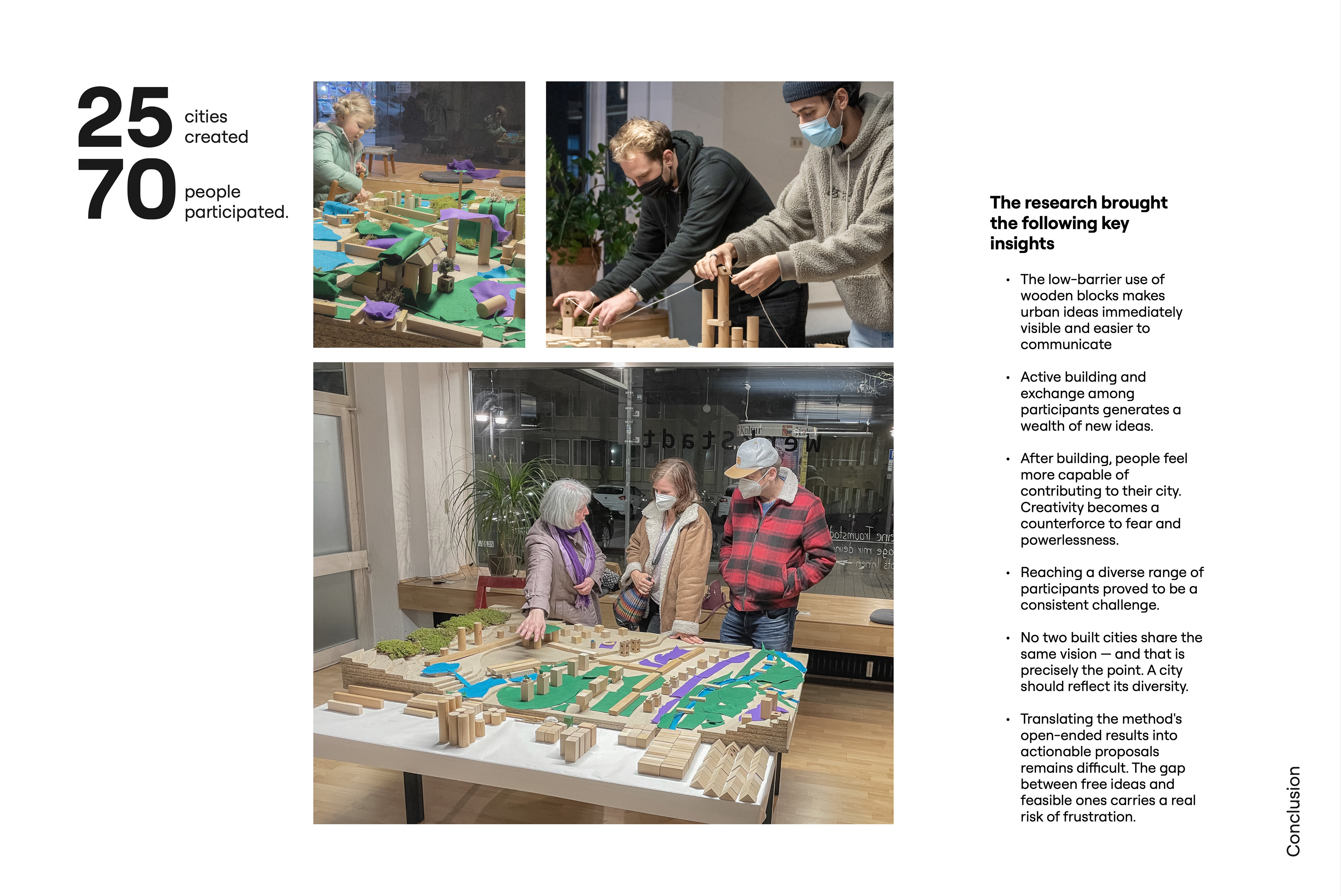
25 cities created. 70 people participated. Three photos: a child builds with wooden blocks and green and purple felt; two men in face masks stretch a string between wooden towers; an older woman, a younger woman and a man in a checked shirt stand around the topographic model in the shop. Text: The research brought the following key insights. The low-barrier use of wooden blocks makes urban ideas immediately visible and easier to communicate. Active building and exchange among participants generates a wealth of new ideas. After building, people feel more capable of contributing to their city. Creativity becomes a counterforce to fear and powerlessness. Reaching a diverse range of participants proved to be a consistent challenge. No two built cities share the same vision, and that is precisely the point. A city should reflect its diversity. Translating the method's open-ended results into actionable proposals remains difficult. The gap between free ideas and feasible ones carries a real risk of frustration.
Thanks to everyone who contributed to this project or supported me. Text: Supervision: Prof. Silke Helmerdig. Supervision: Prof. Thomas Gerlach. Vacancy: LAF e.V., Leerstand als Freiraum. Insightful conversations: Ina Gürke and Anita Gondek from the Office for integration support, City of Pforzheim. Possibility to implement workshops: moki and sjr Betriebs gGmbH Stadtjugendring. And everyone who got involved in this participatory experiment. Logos of LAF e.V., moki and sjr Stadtjugendring.
↑Back to Top