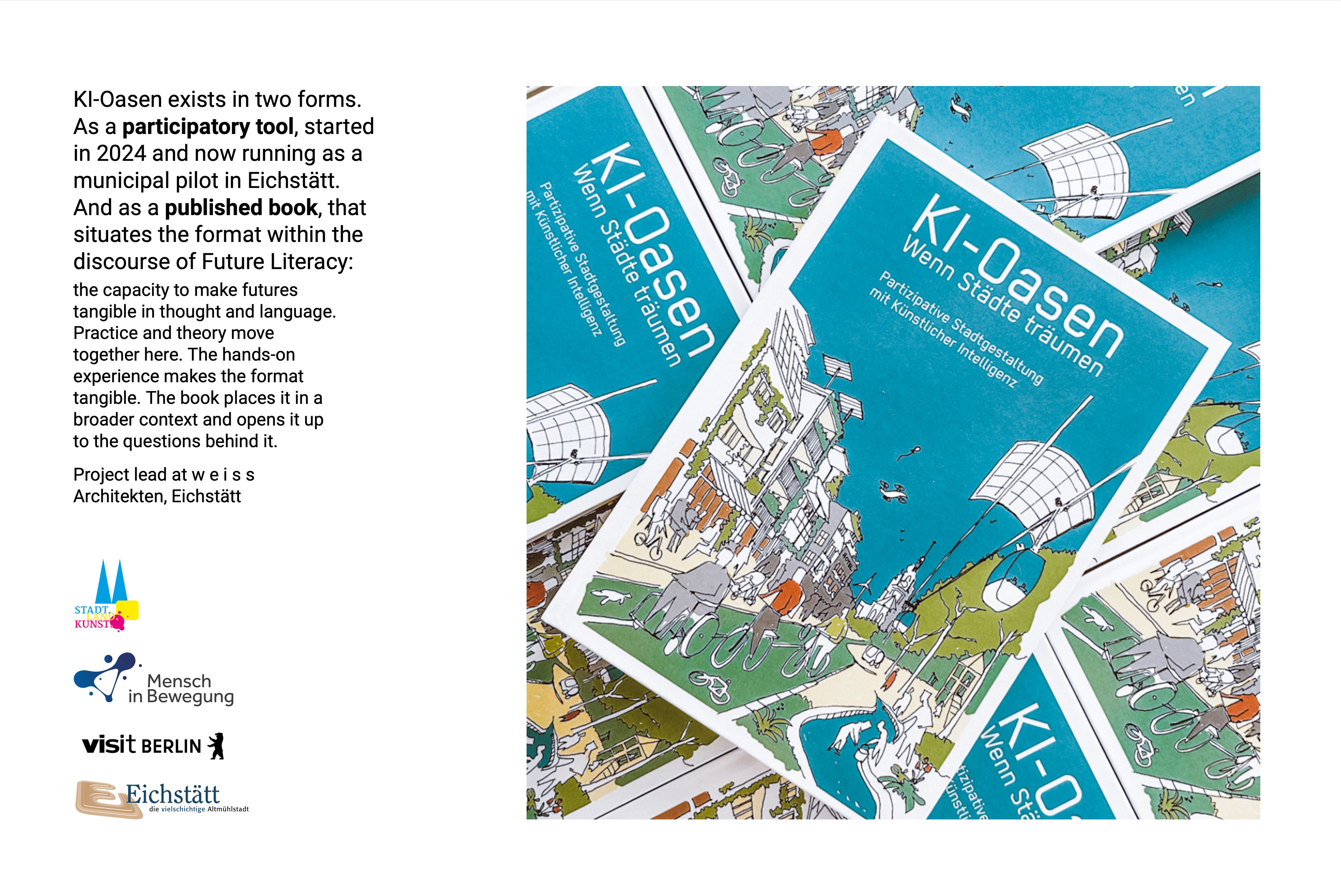
Several copies of the book KI-Oasen: Wenn Städte träumen. Partizipative Stadtgestaltung mit Künstlicher Intelligenz, lying on top of each other; the turquoise cover shows a drawn street scene with cyclists, trees and a cable car. Text: KI-Oasen exists in two forms. As a participatory tool, started in 2024 and now running as a municipal pilot in Eichstätt. And as a published book that situates the format within the discourse of Futures Literacy: the capacity to make futures tangible in thought and language. Practice and theory move together here. The hands-on experience makes the format tangible. The book places it in a broader context and opens it up to the questions behind it. Project lead at weiss Architekten, Eichstätt. Logos of Stadt.Land.Kunst, Mensch in Bewegung, visit Berlin and Eichstätt.
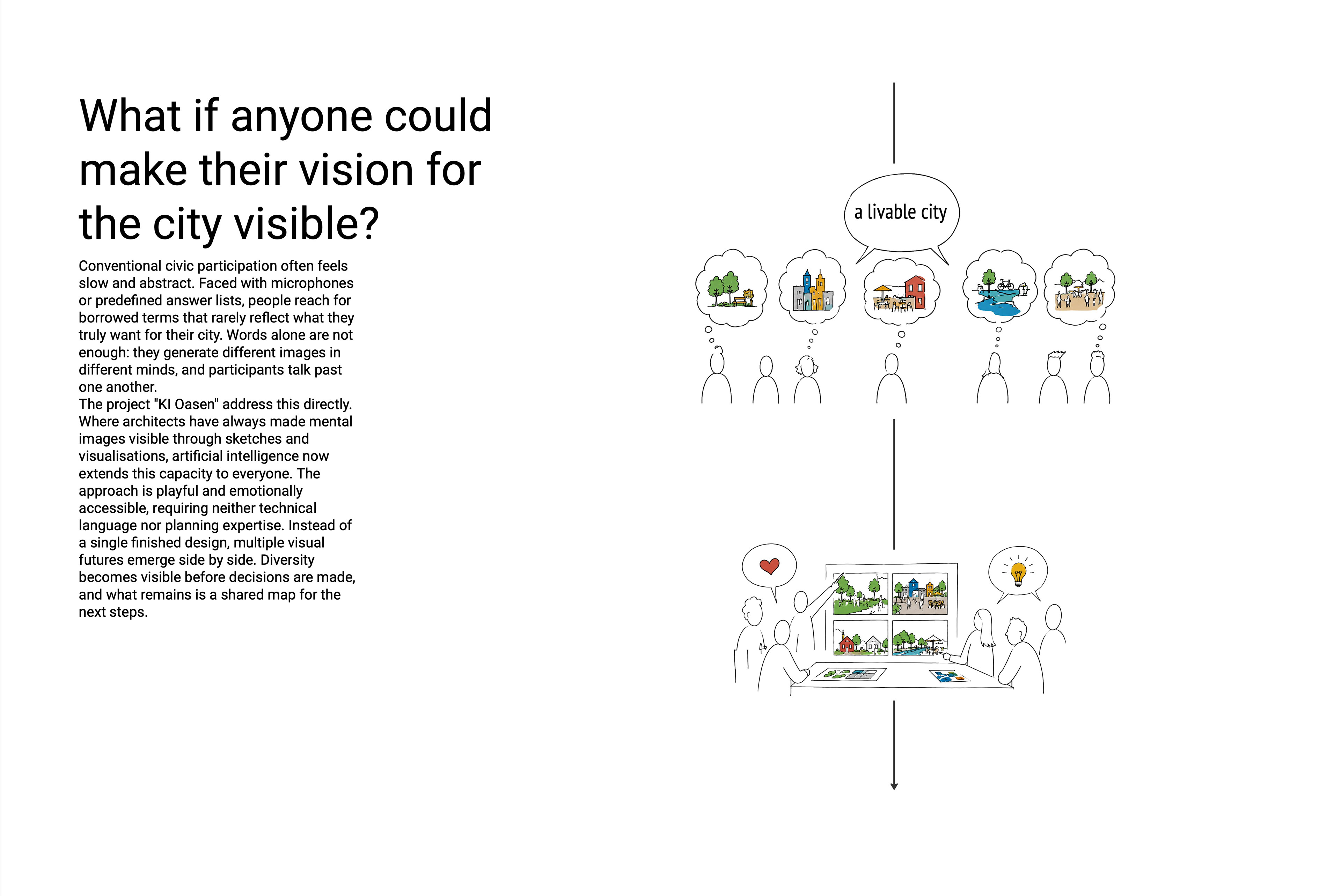
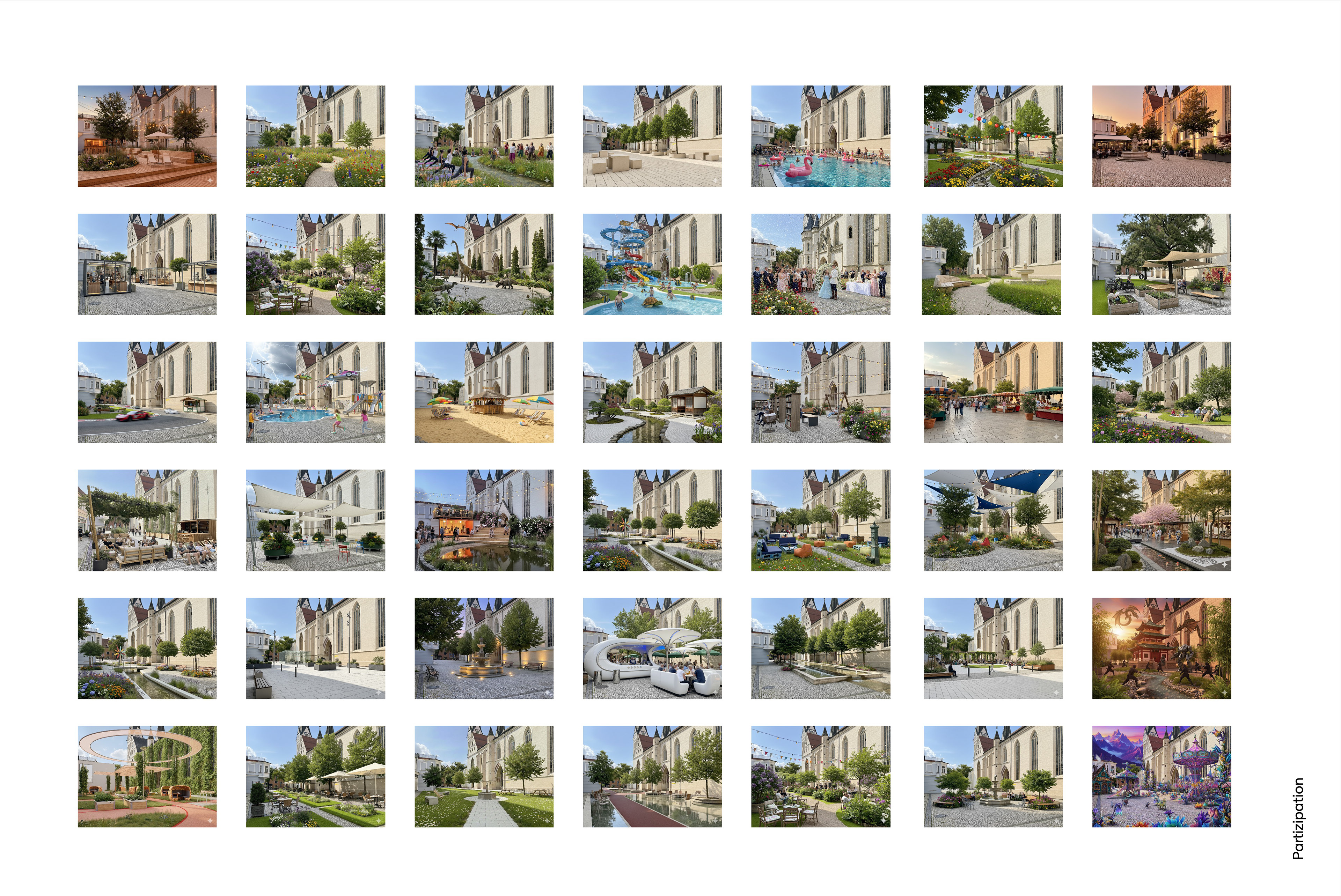
What if anyone could make their vision for the city visible? Drawing: people stand under a speech bubble reading a livable city, and each of them imagines a different picture, from a park to a café square; below, a group gathers around a board of four city images, with a heart and a light bulb above them. Text: Conventional civic participation often feels slow and abstract. Faced with microphones or predefined answer lists, people reach for borrowed terms that rarely reflect what they truly want for their city. Words alone are not enough: they generate different images in different minds, and participants talk past one another. The project KI-Oasen addresses this directly. Where architects have always made mental images visible through sketches and visualisations, artificial intelligence now extends this capacity to everyone. The approach is playful and emotionally accessible, requiring neither technical language nor planning expertise. Instead of a single finished design, multiple visual futures emerge side by side. Diversity becomes visible before decisions are made, and what remains is a shared map for the next steps.
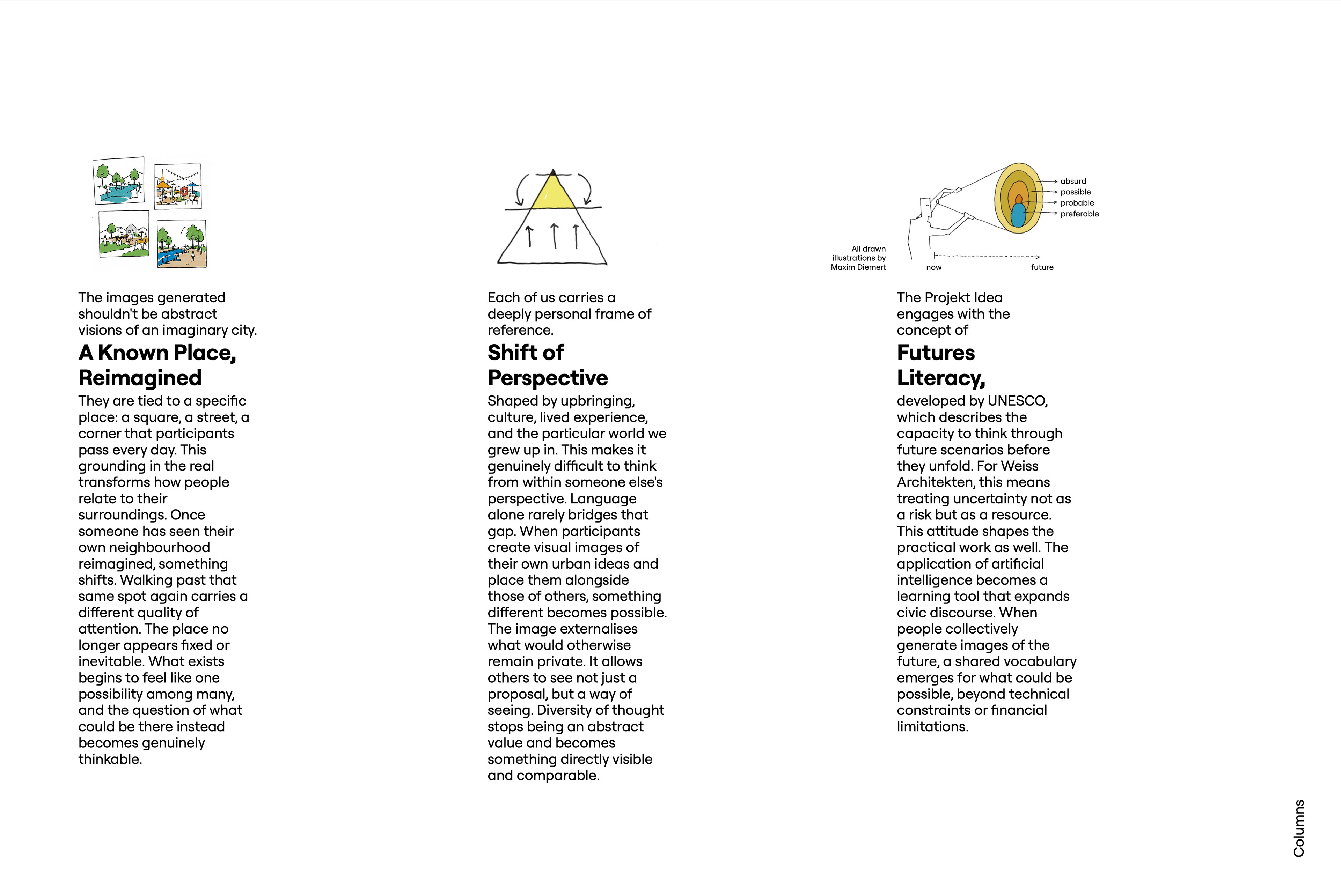
Three columns, each with a small drawing. A Known Place, Reimagined: four small pictures of the same square, each redesigned differently. The images generated shouldn't be abstract visions of an imaginary city. They are tied to a specific place: a square, a street, a corner that participants pass every day. This grounding in the real transforms how people relate to their surroundings. Once someone has seen their own neighbourhood reimagined, something shifts. Walking past that same spot again carries a different quality of attention. The place no longer appears fixed or inevitable. What exists begins to feel like one possibility among many, and the question of what could be there instead becomes genuinely thinkable. Shift of Perspective: a triangle with arrows pointing upwards and its yellow tip flipped over. Each of us carries a deeply personal frame of reference. Shaped by upbringing, culture, lived experience, and the particular world we grew up in. This makes it genuinely difficult to think from within someone else's perspective. Language alone rarely bridges that gap. When participants create visual images of their own urban ideas and place them alongside those of others, something different becomes possible. The image externalises what would otherwise remain private. It allows others to see not just a proposal, but a way of seeing. Diversity of thought stops being an abstract value and becomes something directly visible and comparable. Futures Literacy: a person looks through a telescope at nested circles labelled absurd, possible, probable and preferable, on an arrow from now to future. The project idea engages with the concept of Futures Literacy, developed by UNESCO, which describes the capacity to think through future scenarios before they unfold. For weiss Architekten, this means treating uncertainty not as a risk but as a resource. This attitude shapes the practical work as well. The application of artificial intelligence becomes a learning tool that expands civic discourse. When people collectively generate images of the future, a shared vocabulary emerges for what could be possible, beyond technical constraints or financial limitations. All drawn illustrations by Maxim Diemert.
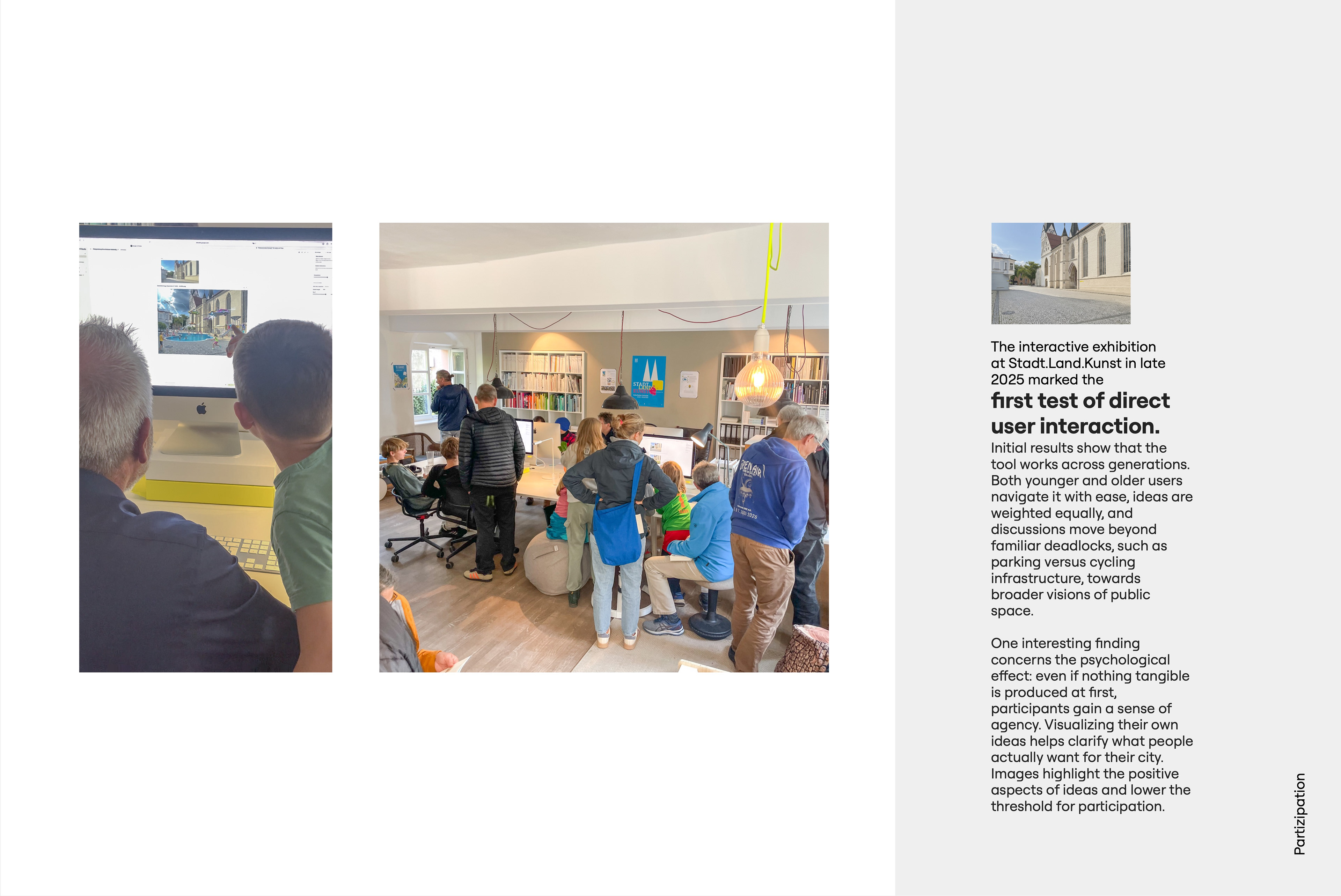
Two photos from the exhibition and a small photo of the real square: a man points at an AI-generated image of the square on a computer screen; in a room with bookshelves, children and adults gather around several computers; the small photo shows the empty cobbled square beside a Gothic church. Text: The interactive exhibition at Stadt.Land.Kunst in late 2025 marked the first test of direct user interaction. Initial results show that the tool works across generations. Both younger and older users navigate it with ease, ideas are weighted equally, and discussions move beyond familiar deadlocks, such as parking versus cycling infrastructure, towards broader visions of public space. One interesting finding concerns the psychological effect: even if nothing tangible is produced at first, participants gain a sense of agency. Visualizing their own ideas helps clarify what people actually want for their city. Images highlight the positive aspects of ideas and lower the threshold for participation.
Grid of 42 AI-generated images of the same square beside a Gothic church, each showing a different vision by participants: from flower meadows, shaded cafés and water channels to a pool with flamingo floats, dinosaurs, a race track and colourful fantasy worlds.
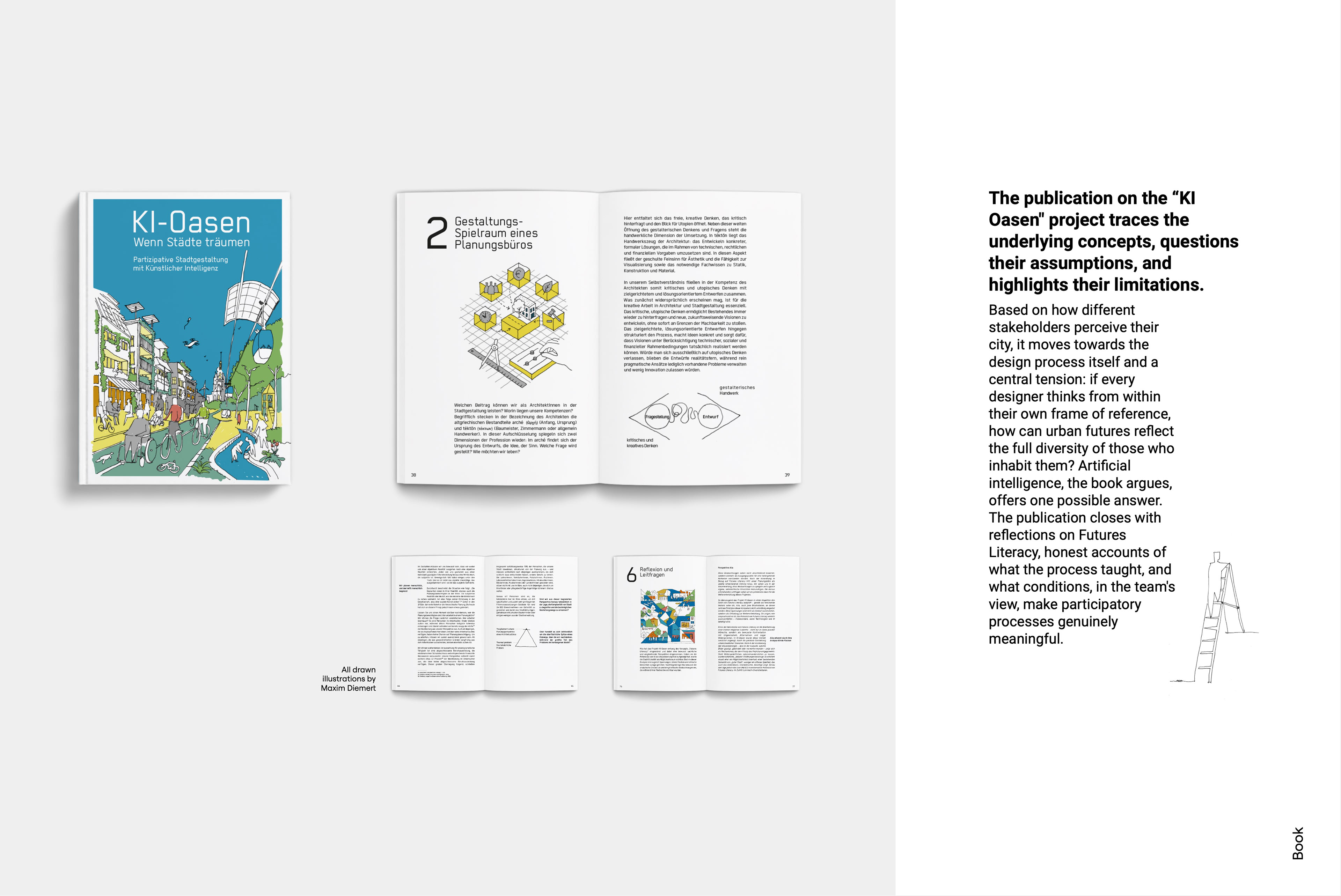
The publication on the KI-Oasen project traces the underlying concepts, questions their assumptions, and highlights their limitations. The book KI-Oasen: Wenn Städte träumen. Partizipative Stadtgestaltung mit Künstlicher Intelligenz, shown with its illustrated cover and three open spreads in German, including chapter 2, Gestaltungs-Spielraum eines Planungsbüros, and chapter 6, Reflexion und Leitfragen; beside the text, a line drawing of a figure climbing a ladder. Text: Based on how different stakeholders perceive their city, it moves towards the design process itself and a central tension: if every designer thinks from within their own frame of reference, how can urban futures reflect the full diversity of those who inhabit them? Artificial intelligence, the book argues, offers one possible answer. The publication closes with reflections on Futures Literacy, honest accounts of what the process taught, and what conditions, in the team's view, make participatory processes genuinely meaningful. All drawn illustrations by Maxim Diemert.
© All copyrights belong to weiss Architekten, Eichstätt.
↑Back to Top