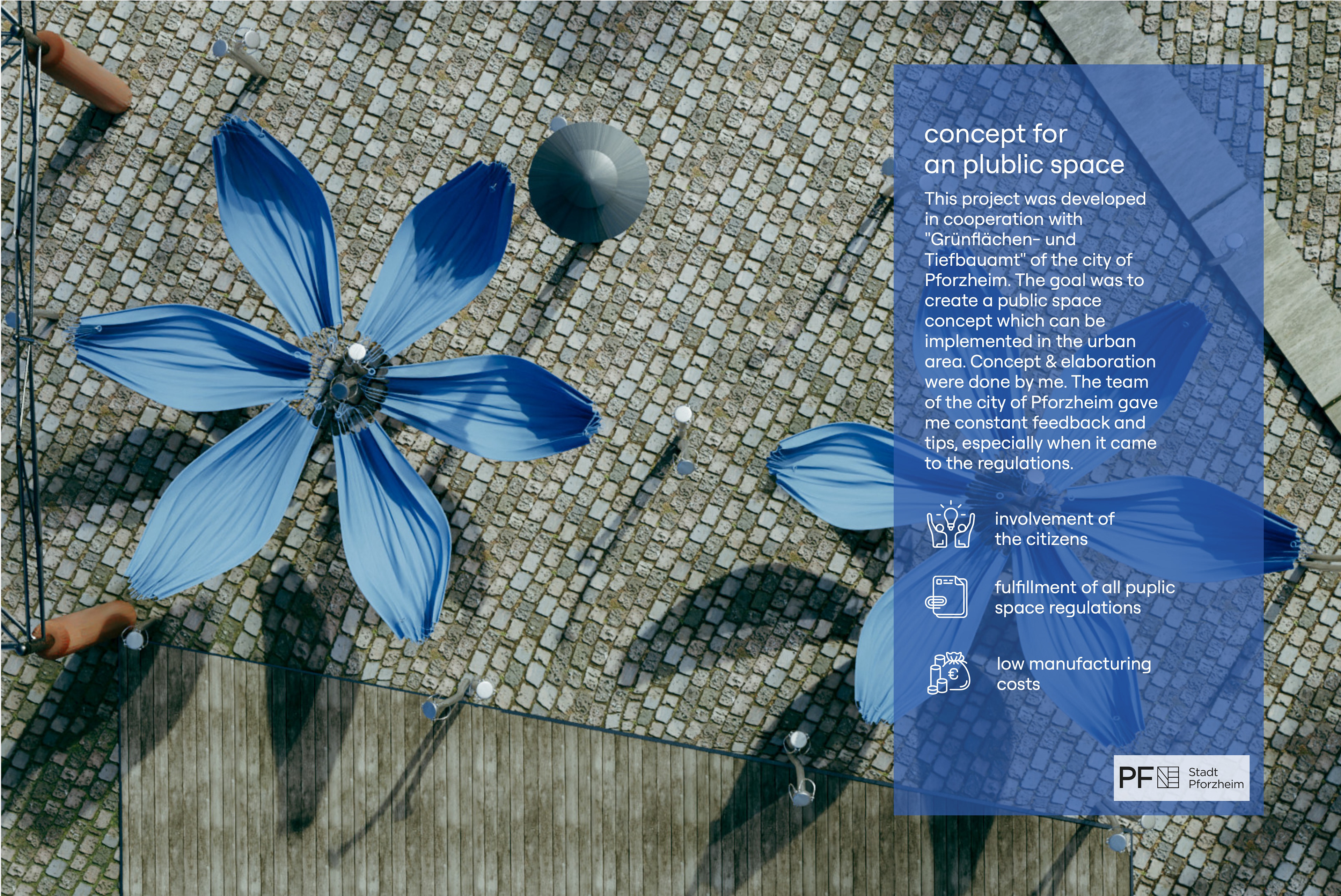
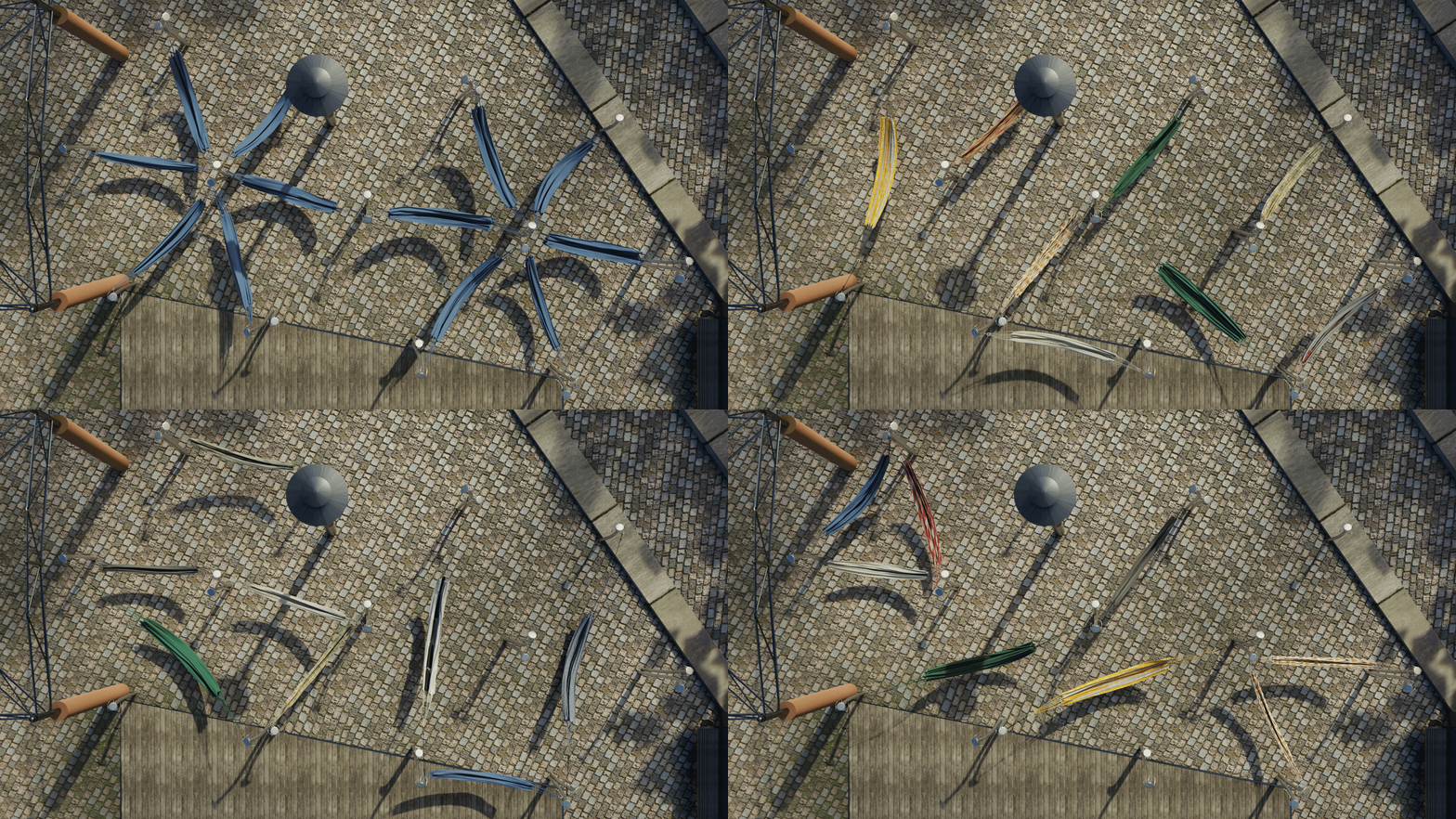
concept for a public space. Rendering from above: blue hammocks hang between slim steel posts on a cobbled square, arranged like the petals of two large flowers. Text: This project was developed in cooperation with "Grünflächen- und Tiefbauamt" of the city of Pforzheim. The goal was to create a public space concept which can be implemented in the urban area. Concept & elaboration were done by me. The team of the city of Pforzheim gave me constant feedback and tips, especially when it came to the regulations. Three icons with the goals: involvement of the citizens, fulfillment of all public space regulations, low manufacturing costs. Stadt Pforzheim logo.
Survey Question: What do you need to feel good in the city of Pforzheim? Blue map of the Pforzheim city center with pins marking where the survey took place. Text: To begin, I wanted to understand what the citizens of Pforzheim actually need. I took to the streets, visited shops and grocery stores, and met with local clubs and institutions. 43% a vibrant city is important. 31% a city needs fun leisure activities. 24% a city needs diversity. 41% it is important to feel a sense of belonging. 38% a clean city is the basic requirement. Map legend: Store surveys, Streetwork Pforzheim, Bürgerverein Nordstadt e.V., LAF - Leerstand als Freiraum e.V., Grünflächen- und Tiefbauamt / Pforzheim.
One part of the design is left to the citizens. Drawing: an empty hexagonal grid labelled the given framework, an arrow pointing down, and the same grid filled with many different hand-drawn patterns, labelled completed by its citizens. Text: These statements, as well as some observations during my walks through the city, gave me the idea.
Diagram with the columns Action and Impact: forms of participation run from passive to active participation (watching, visiting, bring something, shopping, vote, give something, take part) beside two opposing wedges, Quantity, easy to achieve but low impact, and Quality, difficult to achieve but biggest impact; a dashed line marks bring something. Text: How to actively involve the citizens? It was important to me to make participation as accessible as possible. "Bring Something" does not have a big hurdle and could therefore appeal to a large number of people. What should be brought along? Hammocks. This idea has another good side effect: Normally, street furniture can't be made so cozy because it is usually destroyed by vandalism. If everyone brings their own hammock (and takes it home again), only the frames need to be designed according to public requirements.
Designed to support, not to be seen. Three renderings on a cobbled square by the river in Pforzheim: blue hammocks hang between curved stainless steel posts, a close-up shows a post head with hooks holding two hammocks, and the empty posts stand on the square. Text: Kept deliberately minimal, the structures serve as a neutral backdrop rather than a visual statement. When the hammocks are not in use, the frames do not compete with the space. When they are, the hammocks themselves carry the design. The form draws inspiration from the mature bloom of a flower. To test how the structures would read in their specific location, the design was built in Blender with a Google Street View sphere as background, allowing the idea to be communicated to local stakeholders in a way that is specific to their location.
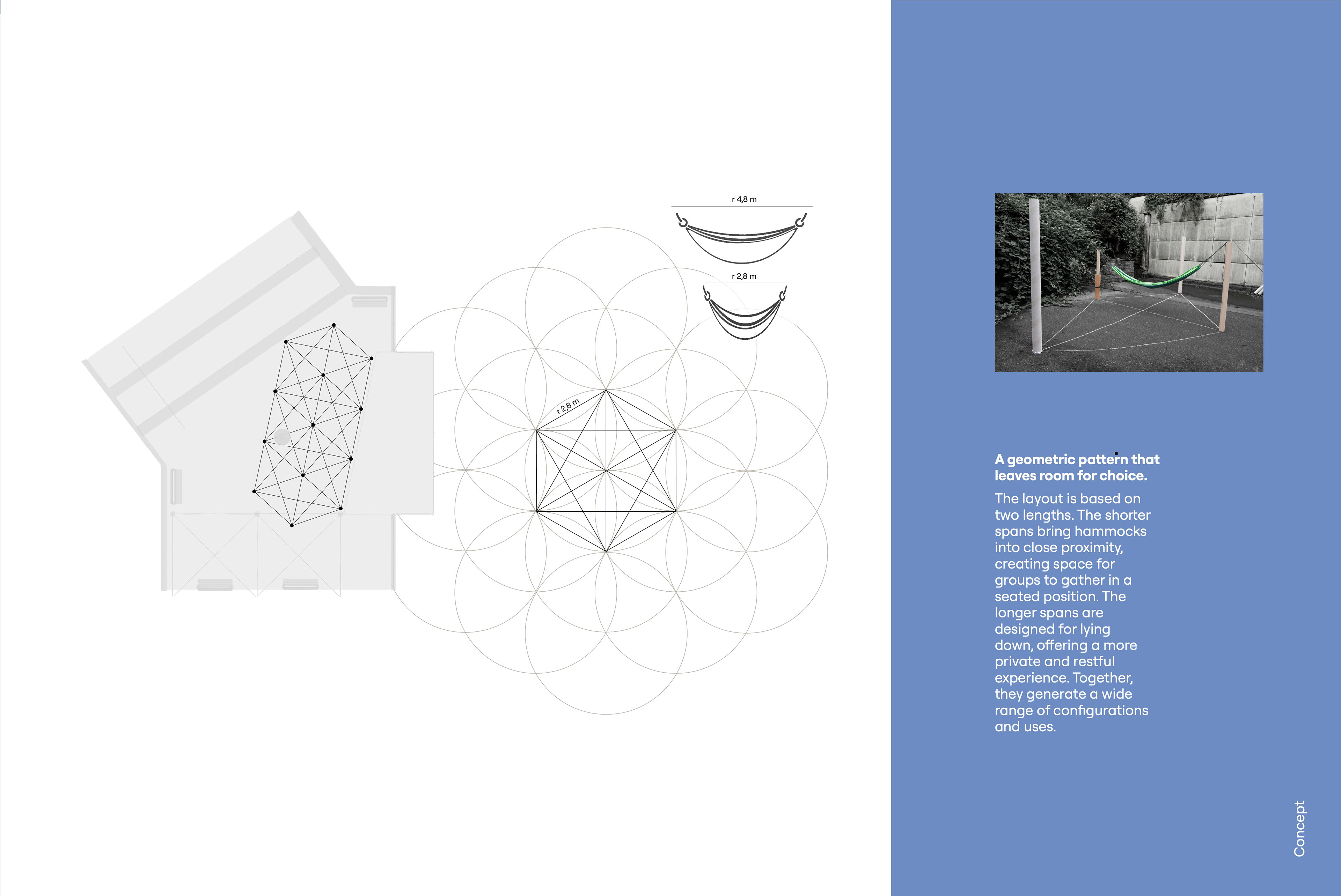
A geometric pattern that leaves room for choice. Site plan with a grid of post positions, a construction drawing of overlapping circles with a radius of 2.8 m, two hammock sketches marked r 4.8 m and r 2.8 m, and a photo of a green hammock hung between posts in a courtyard, with the layout marked on the ground. Text: The layout is based on two lengths. The shorter spans bring hammocks into close proximity, creating space for groups to gather in a seated position. The longer spans are designed for lying down, offering a more private and restful experience. Together, they generate a wide range of configurations and uses.
Drawing of three curved posts, labelled D-Hanger (lockable), Stainless steel and Stainless steel tube Ø 60 mm; two photos of a man taping full-size outlines of the posts onto a white wall; below, a side view of the hammock structures along the railing of the square, with a human figure for scale. Text: To explore a wide range of formal directions quickly, the process began with wire models. Once a clear direction emerged, the work shifted to 1:1 tape models on the wall, allowing proportions to be tested and refined at full scale.
↑Back to Top